We use technically necessary cookies so that our website works. With your consent, we also use Google services for statistics and marketing (Google Analytics, Google Ads) for reach and performance measurement as well as personalised advertising, and embed external media such as YouTube videos. In the process, data may be transferred to Google LLC in the USA (EU-US Data Privacy Framework, Art. 45 GDPR). You can change or withdraw your choice at any time under “Cookie settings” (at the bottom of every page). More in our privacy policy.
Provider: Google Ireland Limited (Ireland), YouTube/Google. When the video is loaded, data, in particular your IP address, is transmitted to YouTube/Google; cookies may be used in the process. A transfer to Google LLC in the USA is possible (EU-US Data Privacy Framework, Art. 45 GDPR). “Load YouTube video” starts this video. If cookie settings are available, the click also counts as consent to the category External media / videos. If the choice is saved in the browser, it applies for up to 12 months; otherwise only for this page. With your consent, selected videos can load automatically and muted: only in the visible tab, without reduced motion and without a manual stop. You can withdraw consent in the cookie settings. Privacy notice Automatic, muted loading only after consent to external media. Can be changed under Cookie settings.
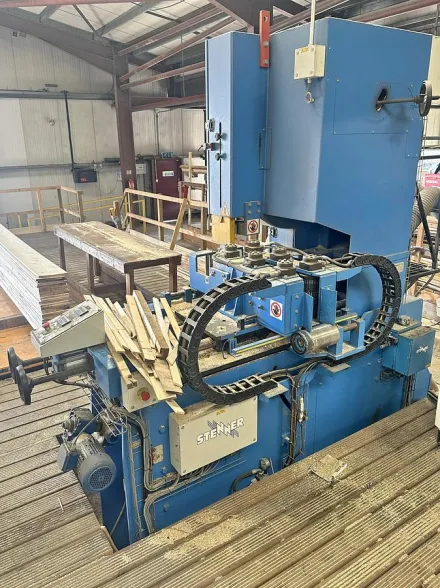
Multi-blade saw Paul BK 34/800
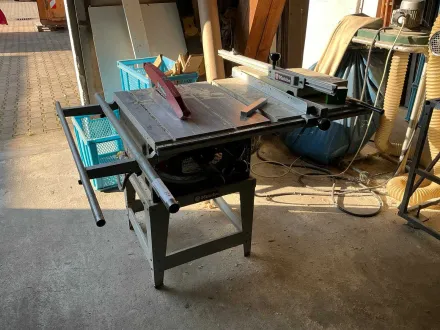
Complete cutting system with cross-cut saw Paul GE 20,
Cutting saw Paul BK 34/800, multi-blade saw BK 34/800
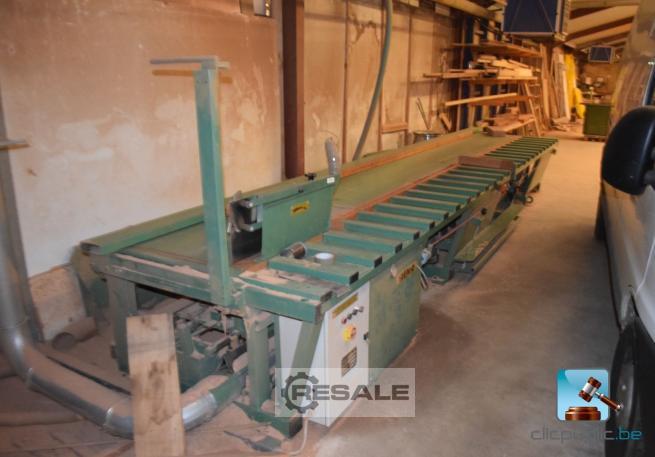
-Chain conveyor with lifting platform
-Cross-cut saw Paul, Type 20 E, YOC 92, 14 kW
-Roller conveyor
-Conveyor with shortage roller
-Ejection station for cuts
-Roller conveyor with centering
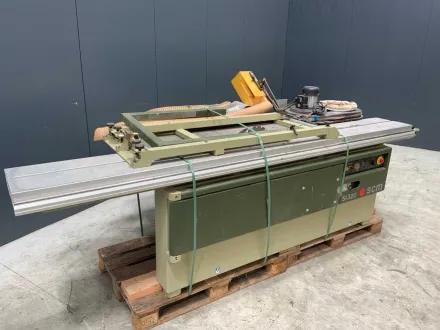
-Separation saw Paul, type BK 34/800, YOC 92, 25 kW
-Transverse survey Paul Type AKA, YOC 92
-Frequent leaf saw Paul Type BK 34/800, YOC 92, 75 kW
-Security channel
-Sorting belt for manual sorting
-Stacking system
Hydraulic pump 11 kW and miscellaneous 15 kW
The system is fully functional, including control cabinets, saw shafts, intermediate rings, saws and documentation.
Hardwood with the following data is processed on the plant:
Wood thickness: 26 mm – 42 mm
Input lengths on the cross-cut saw: 2500 – 5000 mm
Lengths cutting saw/multi-blade saw: 350 – 1000 mm
Strip width: 6 – 30 mm depending on the clamping of the saw shaft
Production:
Starting material: beech lumber 42 mm thick dried to 8 %
The operator places the board on the roller conveyor and transports it to the cross-cut saw. A main length and various shortenings are programmed on the controller.
Lengths from 350 mm to 1000 mm can be processed on this system.
After the board has been cut, it runs over the conveyor belt to a roller conveyor.
Between the conveyor belt and the roller conveyor there is a shortage roller with firewood or firewood.
Cuts fall on the firewood tape. After the shortage roller there is an ejection station for cuts. These are discharged there.
The main lengths run towards the cutting saw and are centered there. After centering, the boards are separated in the middle of the cutting saw. The advantage is, with beech, the boards are usually screwed and would thus clamp in the multi-leaf saw. Another advantage is that you can also cut exactly along the tree edge and have the loss of the narrowest bar in the core area.
After the cutting saw, the halved board is fed to the multi-blade saw via a chain strand. It runs under measuring runners. These measuring runners determine the edge of the tree and the individually driven chain strands align the board in such a way that it is clocked directly into the multi-blade saw at the edge of the tree.
The multi-blade saw has a 75 kW motor and can cut board thicknesses from 26 – 42 mm and lengths from 350 mm to 1000 mm. In strips from 8 mm to 25 mm depending on the clamping of the saw shaft.
After the board has been clocked into the multi-blade saw, it enters a safety channel via a conveyor belt. There it is fed with a chain conveyor to a sorting belt where a person can carry out a quality sorting again.
After the belt, the strips are automatically stacked into transport racks via a chain conveyor.
Inquire about this machine
Your inquiry goes directly to the seller of this machine.